Steiner and Company produces the Profit Maximizer report on behalf of National Pork Board based on information we believe is accurate and reliable. However neither NPB nor Steiner and Company warrants or guarantees the accuracy of or accepts any liability for the data, opinions or recommendations expressed.
Highlights
- Hogs and pigs report expected to show no change in the breeding stock. If true, that would put the breeding stock still about 1% below year ago levels.
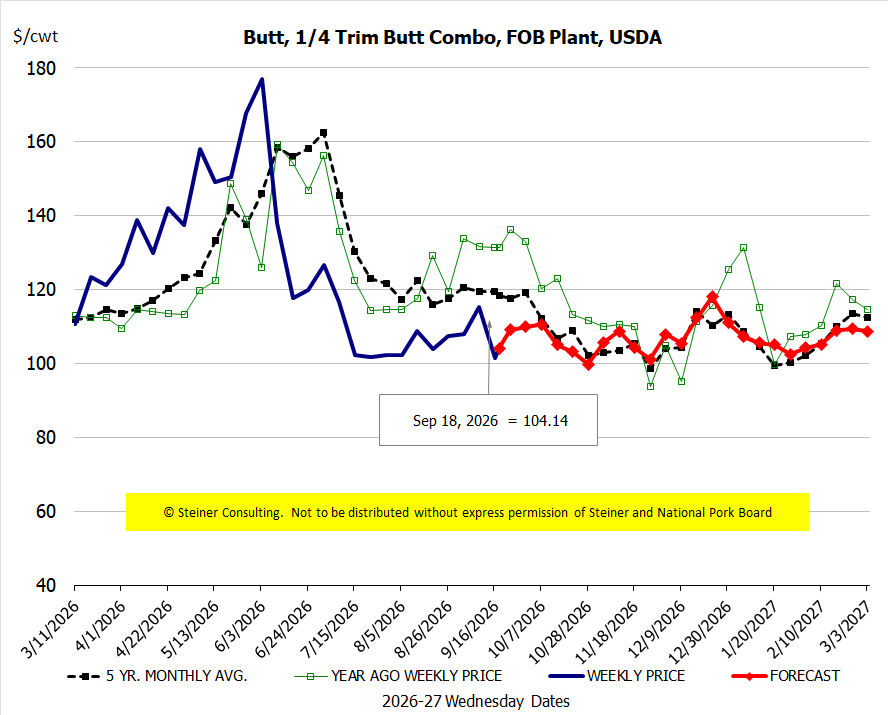
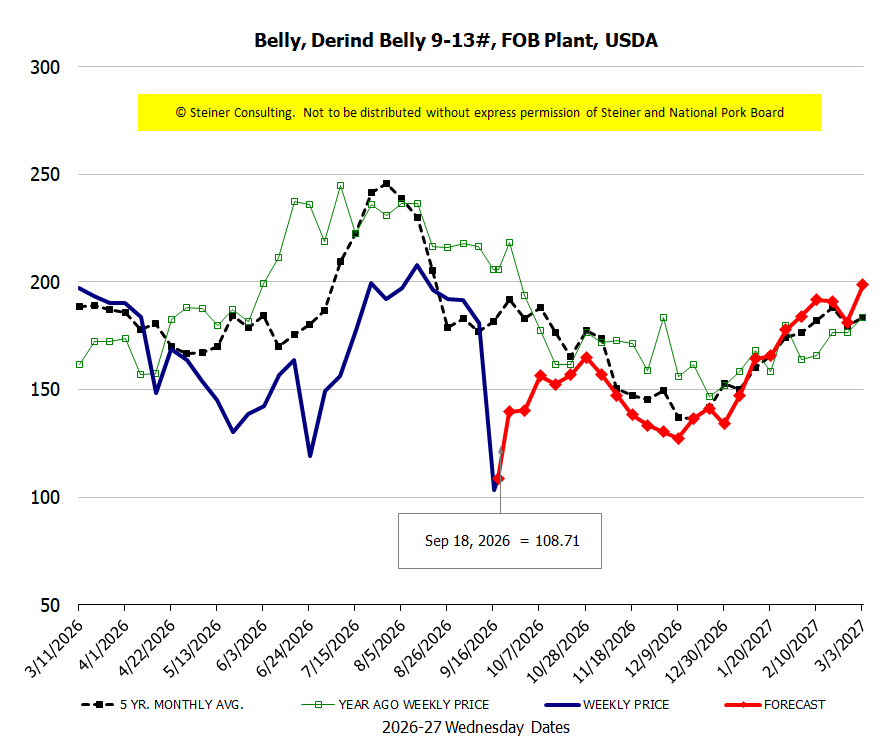
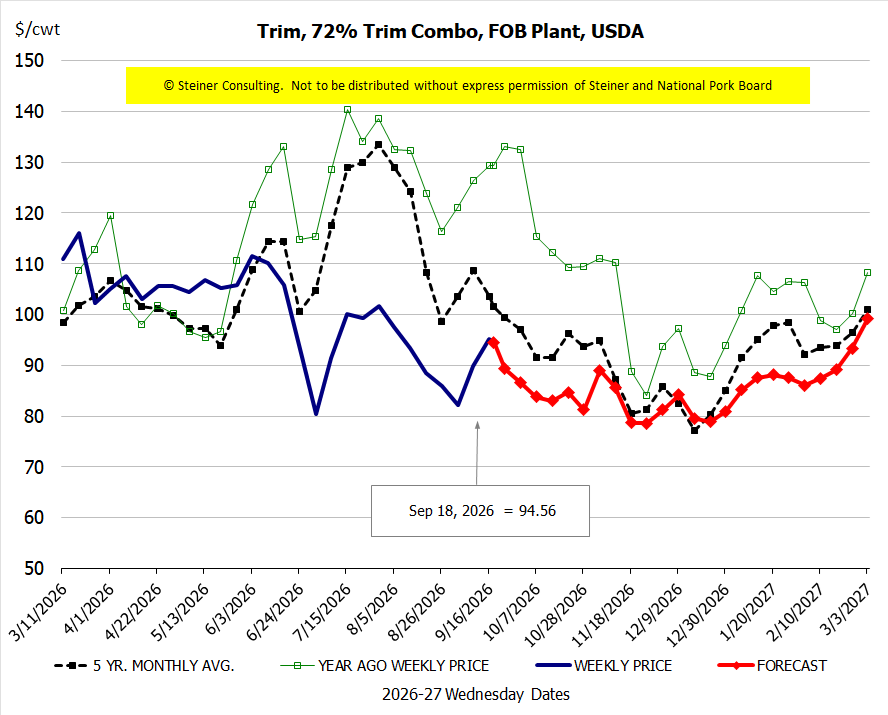
- Pork market doldrums were further amplified last week by the big decline in belly prices. By end of the week the pork cutout was 22% lower than a year ago and more than half of the decline was due to lower belly prices.
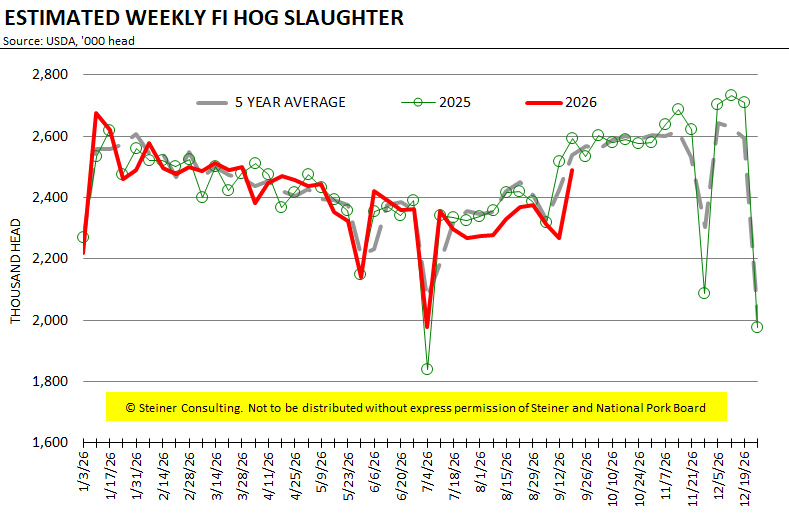
- Hog slaughter is now about 200,000 head higher than a few weeks ago and hog weights are moving seasonally higher. With more spot availability and no interest to put product in the freezer, packer has few options other than lower the price to bolster both domestic and export sales.
- Export sales are showing some improvement and that has helped some items, such as hams. But weakness at retail, impacting loins, butts, and at foodservice, impacting bellies, remains a persistent concern. Futures are now trading at contract lows.
Full Report
USDA will publish on Thursday, September 24 the results of its quarterly survey of hog producers, providing a baseline for pipeline supplies as well as supply growth potential in 2027.
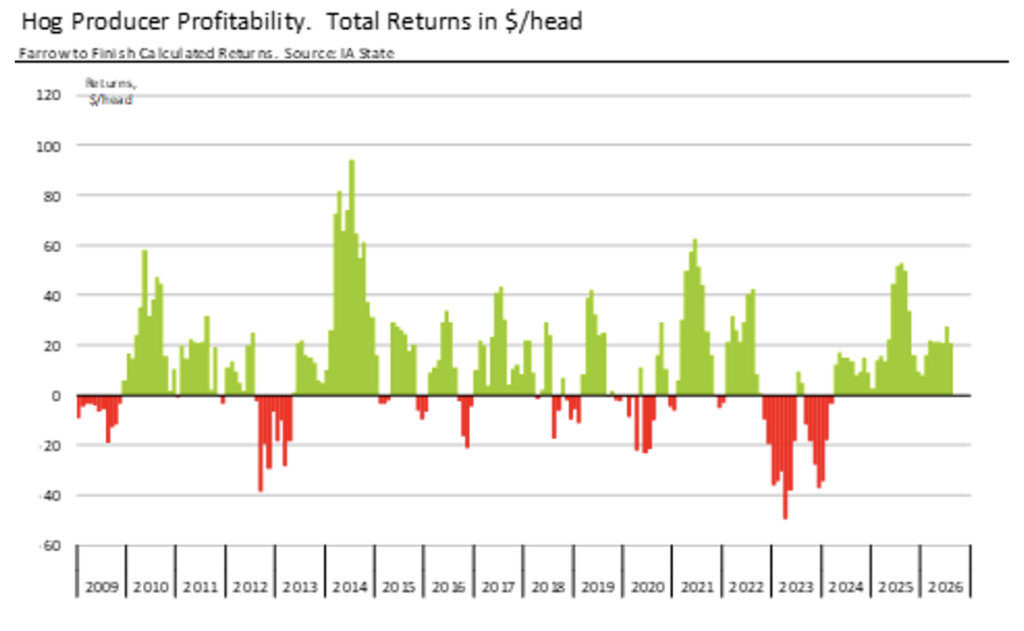
There is a fair amount of speculation as to whether current high feed costs and lower than expected hog prices will result in another round of liquidation. We think that expectation is premature. While forward margins for unhedged producers are currently negative, this follows 2.5 years of good profitability in the industry. Industry is far more concentrated today than in the past and decisions to remove sows are far harder and take longer than before. In 2023 liquidation followed some of the worst losses for the industry in 20+ years. We are in a very different position today.
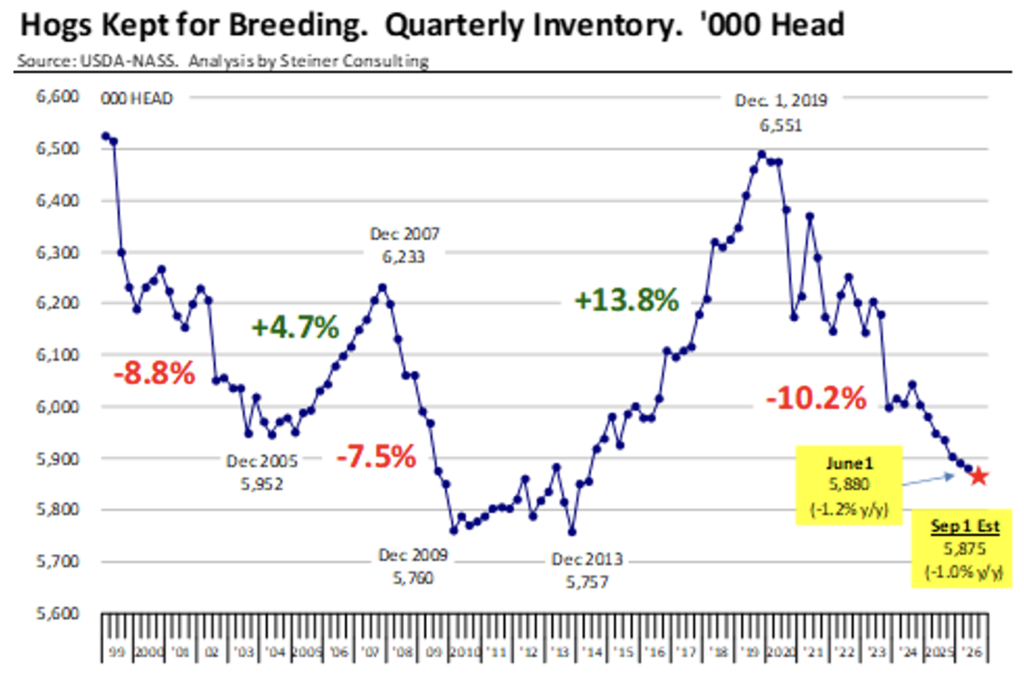
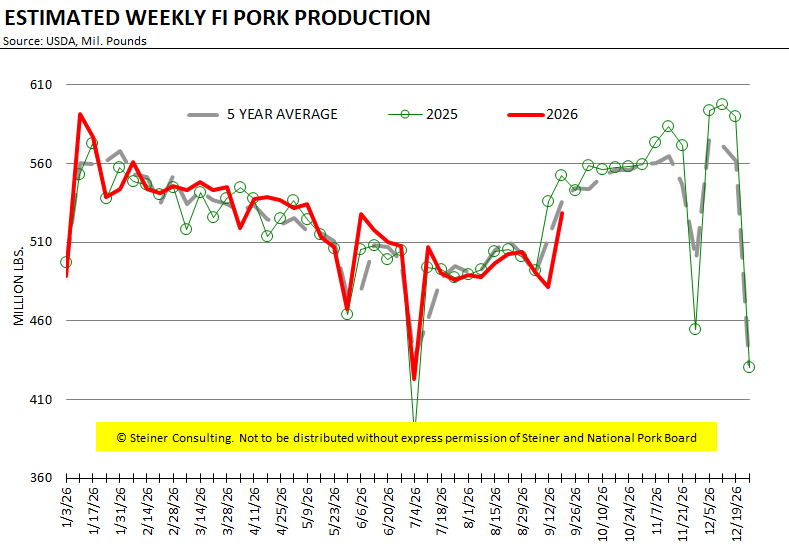
However, while producers may not be liquidating, they have little appetite to add more sows. Our current estimate is that the sow herd on September 1 will be at about the same level as June 1 and 1% lower than a year ago. Sow slaughter has been lower than a year ago but that’s in large part because there are fewer sows. The culling rate is only slightly lower than last year. As it stands, the smaller breeding herd suggests a smaller pig crop over the summer and thus lower y/y supply this coming winter. And different from this year, when ample feed supply/lower prices encouraged producers to feed hogs to heavier weights, we expect weights to be lower y/y. Another factor that will also contribute to lower weights later in the year is the deteriorating margin picture. If producers are losing money on the hogs they sell, they will seek to market their hogs as quickly as possible.
But even as pork supply is expected to be little different, and possibly smaller, than in 2026, demand remains a critical factor for the pork industry in 2027. Retail sales have struggled and we think this has had a significant negative impact on pork. Sharply higher oil prices are only the most visible. But other issues, be this lower SNAP participation, popularity of GLP-1 medications, lower population growth, higher debt burden for lower income households, have all combined to impact spending at the grocery store.
Foodservice spending may be still expanding but not all segments are performing well. Quick service restaurants, which we would argue use more pork items (e.g. bacon and sausage for breakfast or ham for lunch sandwiches) have reported a slowdown in customer traffic.
Global Hog Market Prices
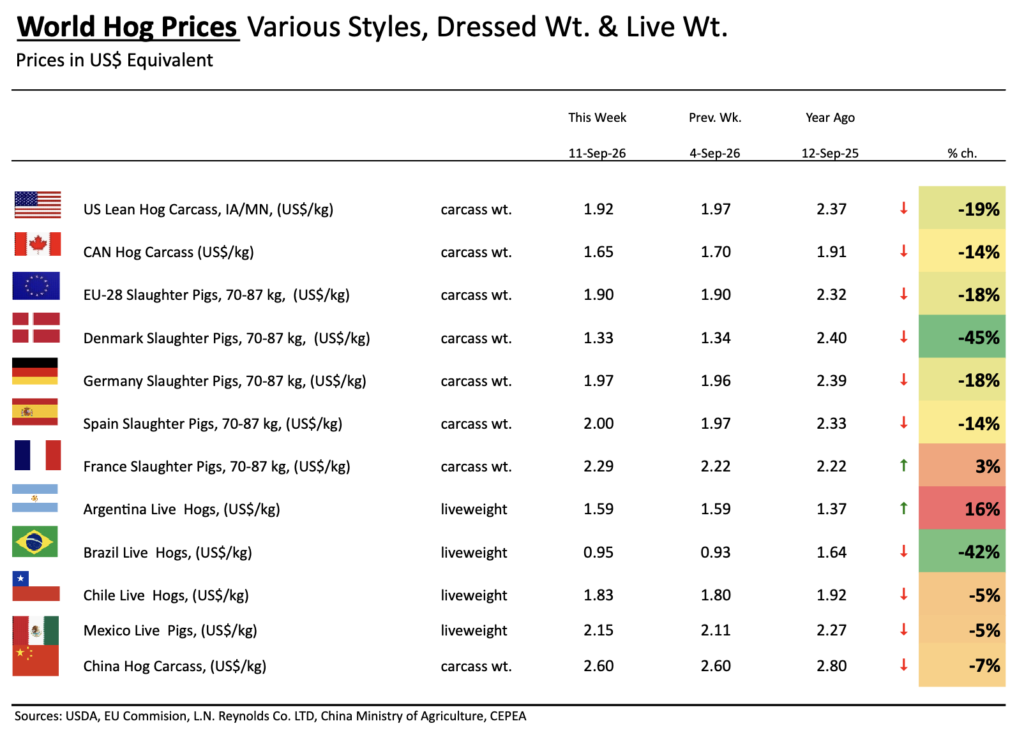
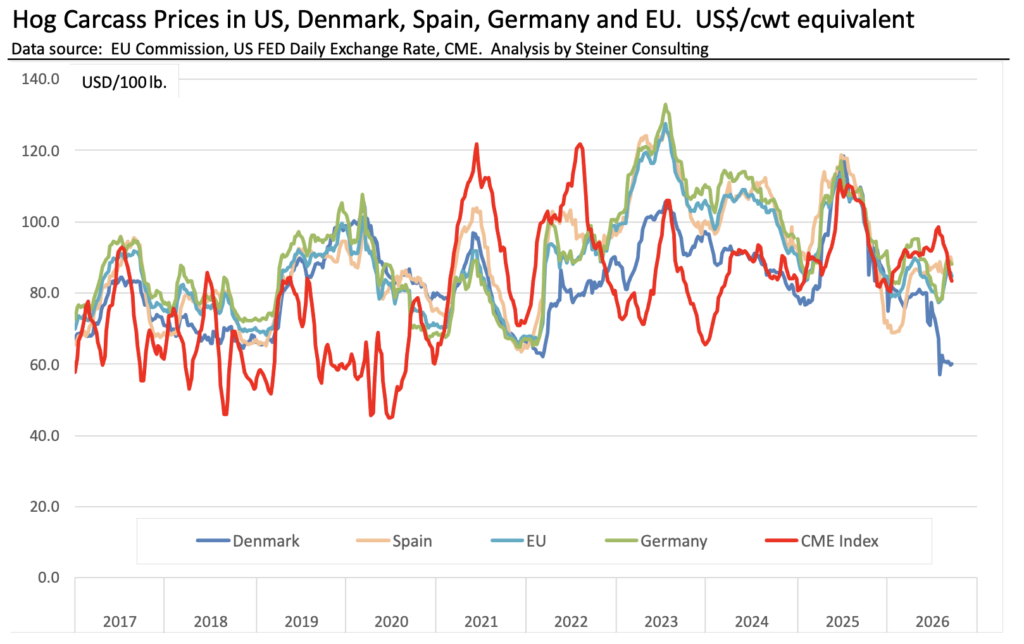
Further adding to the demand weakness is the increasingly competitive global marketplace. Exports account for a quarter of US pork production and for some primal (hams, picnics) they are almost half. Hog prices in key global export markets (Brazil, Denmark, Spain, Canada) are down significantly vs. a year ago. The table to the right shows quoted hog values in US $/kg for a range of countries. We think of most interest is the price comparison to the right. Hog prices in Brazil are currently running around 42% lower than a year ago while prices in Denmark, one of the biggest exporters in the world is down 45% y/y. Prices in other EU countries are not down as much as they are in Denmark and the main reason is that those countries do not depend on exports as much as Denmark does. Restrictions due to African Swine Fever for German, Italian, Polish and some Spanish pork have resulted in more competition within the EU. Tariffs in China and increased competition from US and Brazil have impacted exports outside the EU. Brazil, a country that expanded its production in part to support growing demand from China but also due to increase in feed production, has been pushing aggressively to sell product to other markets. Brazilian exports to Japan, one of the top markets for US pork, are currently over 70% higher than a year ago while exports to S. Korea, while relatively small, are up over 35%. Additionally Brazil is shipping pork to the Dominican Republic and the Philippines, which in the past have been important markets for US pork. This underscores a key demand challenge for US pork producers and will further impact herd rebuilding decisions.
Price Chart
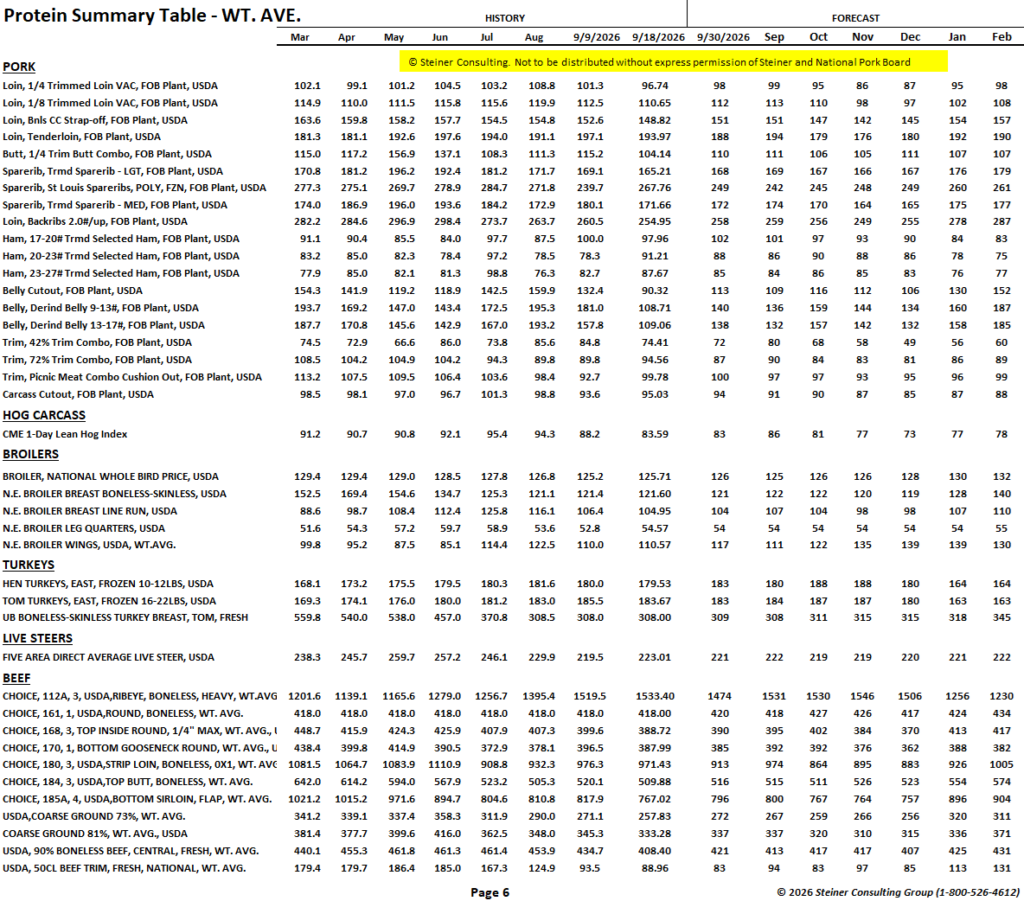
Forecasts
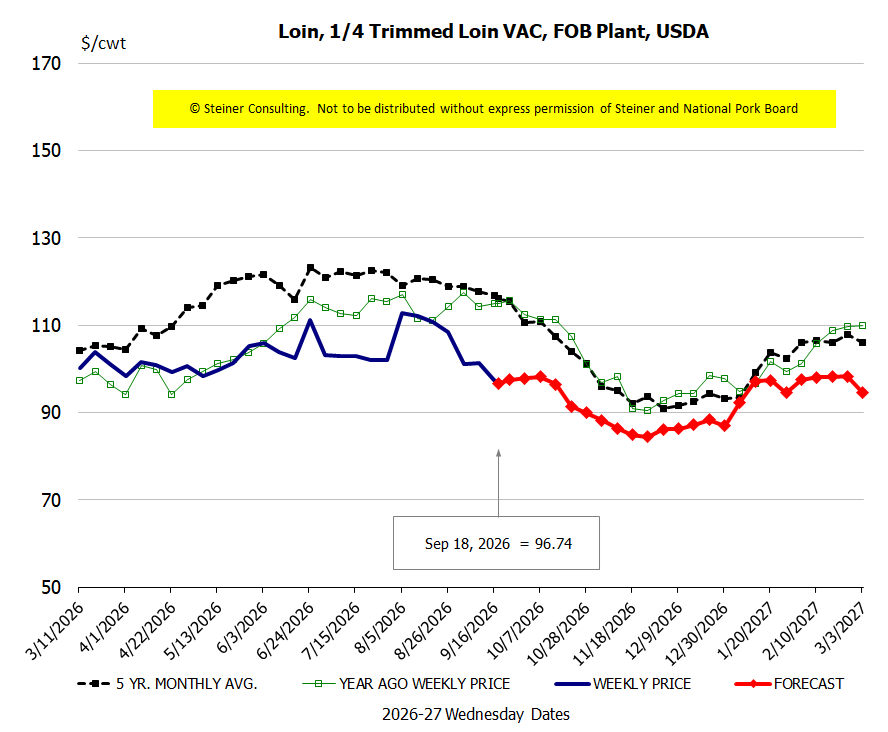
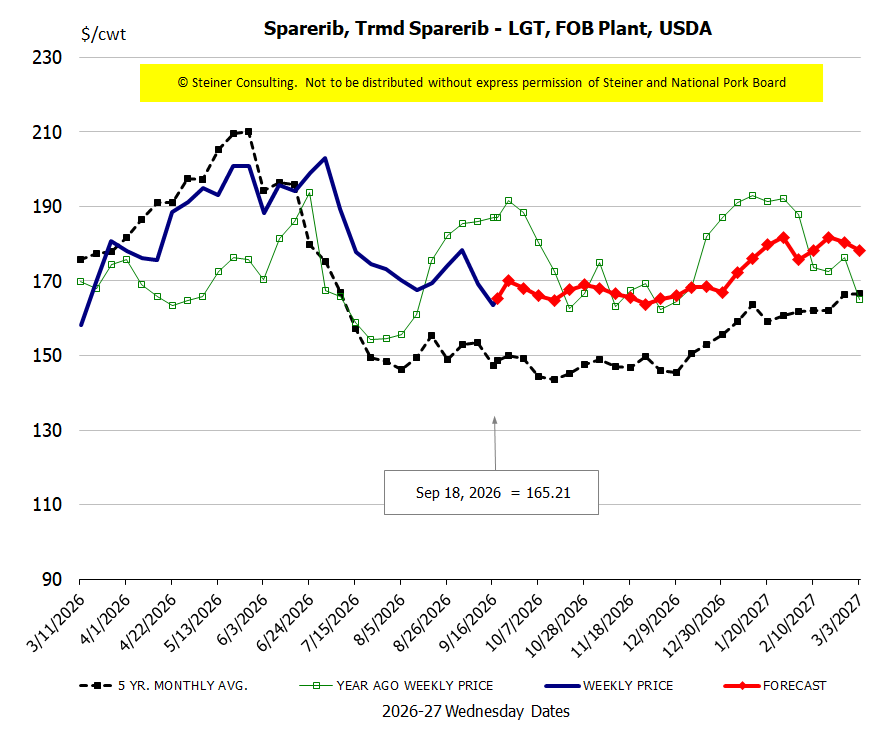
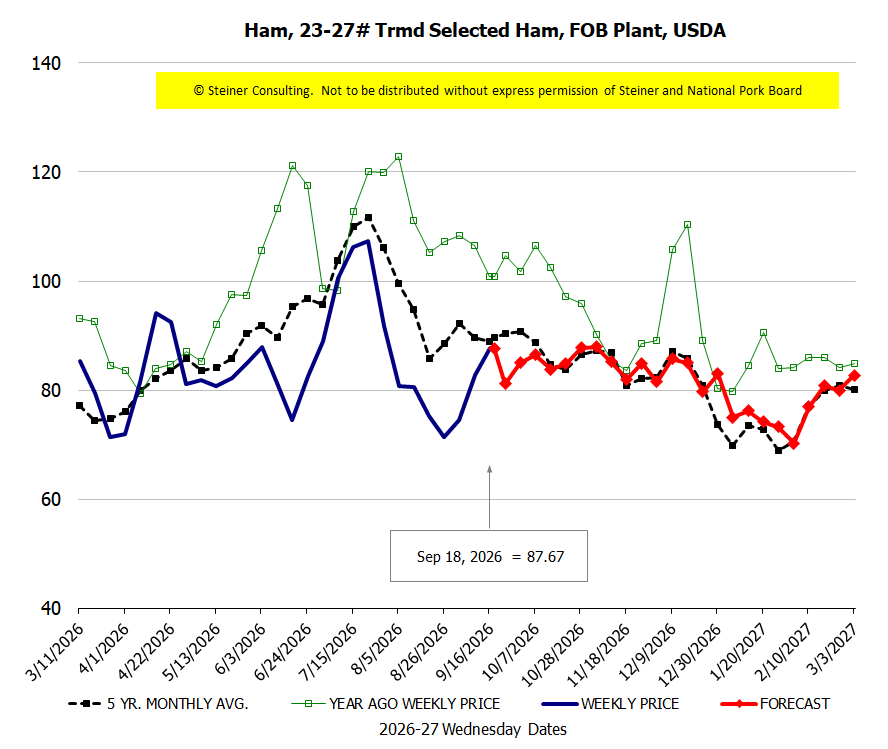
Steiner Consulting Group produces the National Pork Board newsletter based on information we believe is accurate and reliable. However, neither NPB nor Steiner and Company warrants or guarantees the accuracy of or accepts any liability for the data, opinions or recommendations expressed.


